

The portable toilet market is set to reach USD 41.3 billion by 2035, driven by eco-friendly innovations.
Portable toilet market
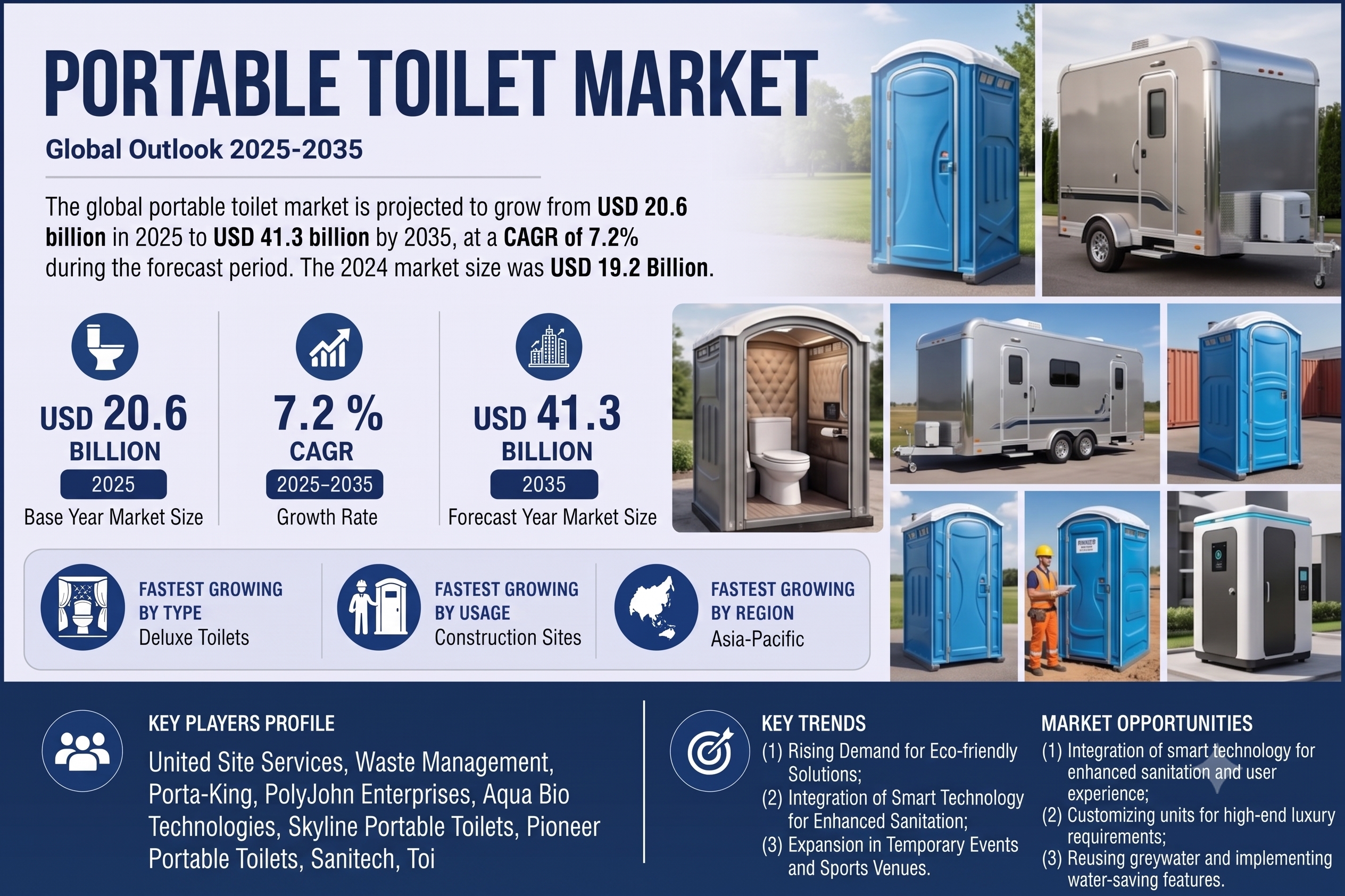
Portable toilet market grows from USD 19.2 billion in 2024 to USD 41.3 billion by 2035, supported by sustainability, technology, and rising hygiene needs.
The portable toilet industry is evolving through sustainability, smart technology, and rising hygiene standards, creating significant opportunities for innovation and long-term growth worldwide.”
NEW YORK, NY, UNITED STATES, July 21, 2026 /EINPresswire.com/ -- The global portable toilet market is experiencing sustained expansion as sanitation needs rise across construction sites, outdoor events, disaster response operations, public infrastructure projects, commercial facilities, tourism zones, and remote work environments. According to current market estimates, the portable toilet market was valued at USD 19.2 billion in 2024 and is projected to increase to USD 20.6 billion in 2025 before reaching USD 41.3 billion by 2035, reflecting a compound annual growth rate (CAGR) of 7.2% during the forecast period from 2025 to 2035.— Market Research Future (MRFR)
This growth reflects a broader transformation in sanitation planning, where portable toilets are no longer viewed as temporary convenience units alone, but as essential infrastructure for health, safety, compliance, and environmental responsibility. As governments, businesses, and event organizers place greater emphasis on hygiene standards and sustainable operations, portable sanitation solutions are becoming increasingly important across both developed and emerging markets.
The market’s expansion is supported by a combination of regulatory, environmental, and operational factors. Governments and private organizations are prioritizing sanitation access in public and private spaces, while industries such as construction, mining, logistics, agriculture, and outdoor event management continue to depend on temporary restroom infrastructure to support workers, guests, and communities. In parallel, portable toilet manufacturers and service providers are investing in product innovation, including smart features, improved materials, odor-control systems, water-saving technologies, and enhanced user experience solutions.
Get Full PDF Sample Copy of Report: (Including Full TOC, List of Tables & Figures, Chart) @ https://www.marketresearchfuture.com/sample_request/24185
Portable Toilet Market Growth Outlook
The portable toilet market is forecast to gain significant momentum over the next decade as sanitation infrastructure becomes more integrated into temporary, mobile, and remote use cases. One of the strongest drivers is the rising demand for eco-friendly solutions. Environmental concerns are encouraging the adoption of water-efficient systems, biodegradable consumables, and waste management practices that reduce ecological impact. This is especially important in regions where water scarcity, sustainability regulations, and green construction practices are shaping procurement decisions. As a result, buyers are increasingly evaluating sanitation providers not only on price and availability, but also on environmental performance and service efficiency.
Another major growth factor is the increasing need for sanitation in infrastructure-heavy industries. Construction sites, mining operations, road development projects, utility installations, and energy projects often require portable toilets to maintain compliance with workplace safety and hygiene regulations. As infrastructure development accelerates in both urban and rural areas, the need for temporary sanitation support continues to rise. Portable toilets are also widely used in agriculture, film production, military operations, parks, and seasonal work environments, where permanent restroom facilities may not be practical or cost-effective.
Public events and outdoor gatherings are also contributing to market growth. Music festivals, sporting events, fairs, religious gatherings, marathons, exhibitions, and community celebrations depend on large-scale restroom deployment to serve attendees efficiently. The increasing scale and frequency of such events are creating opportunities for rental companies and sanitation service providers to offer more durable, hygienic, and customizable portable toilet solutions. Event organizers are also demanding faster deployment, better aesthetics, improved accessibility, and stronger odor control, which is pushing the market toward higher-value product offerings.
The market is also benefiting from the ongoing modernization of sanitation services. Smart technology is becoming a key opportunity area, with portable toilet systems increasingly incorporating features such as occupancy sensors, remote monitoring, service alerts, and data-driven maintenance scheduling. These innovations help service providers optimize cleaning routes, improve hygiene standards, reduce operational costs, and deliver a more convenient experience for end users. In addition, digital fleet management tools are helping companies track unit location, service frequency, and usage patterns more accurately, improving both operational planning and customer satisfaction.
Demand for Smart and Sustainable Sanitation Solutions
A key opportunity in the portable toilet market is the integration of smart technology for enhanced sanitation and user experience. As digital transformation spreads across facilities management and infrastructure services, portable toilet providers are beginning to use connected systems that improve service efficiency and reliability. Remote monitoring tools can help track usage patterns, detect when units require maintenance, and ensure timely servicing. This not only improves operational productivity but also increases customer satisfaction. For large-scale deployments, especially at festivals, construction zones, and emergency response sites, smart monitoring can reduce downtime and help maintain cleaner, safer conditions.
Sustainability is another defining trend shaping the future of the market. Portable toilet designs are evolving to incorporate recyclable materials, reduced chemical usage, solar-powered components, and waste-reduction strategies. These advancements align with broader environmental goals across construction, public works, and event management industries. Customers are becoming more selective about sanitation solutions, favoring providers that can demonstrate compliance with eco-conscious standards and green operating practices. In many cases, sustainability is now a procurement requirement rather than a differentiator, especially for public sector contracts and environmentally certified projects.
The market is also seeing product-level innovation in design and material selection. Modern portable toilets are being designed for greater durability, easier transport, improved ventilation, and better comfort. Materials that are lightweight, corrosion-resistant, and weather-tolerant are gaining preference, especially in harsh outdoor environments. Design improvements are also helping to enhance privacy, accessibility, and cleanliness, which are increasingly important in both commercial and public-use settings. Premium units may include flushing systems, handwashing sinks, mirrors, lighting, soap dispensers, and touch-free fixtures, while standard units continue to serve high-volume, cost-sensitive applications.
Key Market Dynamics
The portable toilet market is shaped by a strong combination of rising hygiene awareness, environmental regulation, and growing use across temporary and mobile infrastructure applications. One of the primary market dynamics is the rising demand for eco-friendly solutions, which is driving innovation and competition among manufacturers and service providers. Companies are responding with products and services that reduce environmental impact while improving functionality and convenience. This includes better waste containment systems, lower water consumption, improved ventilation, and more efficient servicing models.
Another important dynamic is the expansion of rental-based sanitation models. Many users prefer short-term or project-based access to portable toilets rather than permanent installations. This has strengthened the role of rental firms and sanitation service providers, especially in sectors where mobility, flexibility, and rapid deployment are important. The recurring nature of service contracts also supports long-term market stability and revenue generation. Rental models are particularly attractive for construction projects, seasonal events, emergency deployments, and temporary public works, where demand can change quickly and service responsiveness is critical.
At the same time, expectations around hygiene and cleanliness are becoming more demanding. End users increasingly require better maintenance, more frequent servicing, odor management, hand hygiene features, and improved interior conditions. This is pushing the industry to raise its service standards and invest in better product engineering and maintenance systems. The COVID-19 era also reinforced the importance of sanitation readiness, and many organizations have since maintained higher expectations for cleanliness, touch-free features, and reliable servicing.
Regulatory compliance is another factor influencing market performance. Public health and workplace safety requirements often mandate sanitation access at construction sites and public events. These regulations ensure a baseline level of demand across industries, while also encouraging service providers to improve reliability and quality. In many markets, compliance with accessibility standards, waste disposal rules, and environmental regulations is becoming increasingly important, creating both operational challenges and opportunities for differentiation.
Market Segmentation and Product Evolution
The portable toilet market is segmented across type, usage, design, material, features, and region, reflecting the wide variety of applications and customer preferences. Different use cases require different product specifications, from basic single-unit toilets to more advanced models with enhanced accessibility, handwashing capabilities, odor control, and premium design features. This diversity is helping the market expand across both low-cost and high-value segments.
By type, the market includes standard portable toilets, luxury units, handicap-accessible models, and specialized sanitation solutions. Standard units remain widely used for construction sites and general outdoor applications, while premium and accessible models are gaining traction in event management, hospitality, and public service settings. As accessibility and inclusivity become more important, demand for ADA-compliant or disability-friendly units is also expected to expand. Luxury restroom trailers and upgraded portable units are increasingly used at weddings, corporate events, VIP gatherings, and entertainment venues where comfort and appearance matter as much as functionality.
By usage, portable toilets are deployed in construction, events, emergency response, public infrastructure, tourism, agriculture, and industrial operations. Construction remains one of the largest application areas due to consistent site-based sanitation requirements. Events and public gatherings represent another significant segment, especially in regions with active entertainment and tourism industries. Emergency response and disaster relief also create critical demand when rapid sanitation deployment is needed in affected communities. In addition, remote industrial sites, oil and gas operations, and utility projects rely on portable sanitation to support workforce health and operational continuity.
Design and material innovation continue to influence purchasing decisions. Units made with durable plastics, composite structures, or corrosion-resistant components are increasingly favored for ease of transport and long-term reliability. Features such as ventilation, anti-odor systems, lighting, hand sanitizers, sinks, and touch-free mechanisms are becoming more common as users expect cleaner and more comfortable experiences. The market is also seeing stronger demand for modular and stackable designs that simplify logistics, reduce transport costs, and improve fleet utilization for service providers.
Regional Insights
The portable toilet market spans North America, Europe, APAC, South America, and MEA, with each region contributing to global growth in distinct ways.
North America remains a mature and important market, supported by large construction activity, strong event culture, and established sanitation service providers. The region also shows strong interest in smart sanitation technology and environmentally sustainable restroom systems. Demand is further supported by workplace safety norms, public event infrastructure requirements, and the widespread use of rental sanitation services across commercial and municipal projects. The United States in particular continues to be a major market for both standard and premium portable toilet solutions.
Europe is also an important market, particularly because of strict environmental standards, sustainability goals, and widespread adoption of efficient sanitation solutions. Countries in Europe are increasingly focused on eco-friendly waste management, and this is encouraging investment in portable toilet systems with reduced environmental impact. Demand is also supported by public events, tourism, infrastructure upgrades, and the growing preference for high-quality, accessible sanitation units that align with regional hygiene and environmental expectations.
APAC is expected to be one of the most dynamic growth regions over the forecast period. Rapid urbanization, infrastructure development, population growth, and expanding event activity are driving strong demand for portable sanitation. As construction and public works projects increase across the region, portable toilet deployment is becoming more important for operational compliance and public hygiene. In many APAC markets, the combination of large-scale infrastructure investment and rising public sanitation awareness is creating strong opportunities for both local and international providers.
South America is witnessing gradual growth supported by urban development, public gatherings, and industrial expansion. MEA also presents opportunities as infrastructure projects, tourism activity, and public sanitation needs increase in both developed and developing markets. In these regions, portability, durability, and cost-effectiveness remain important buying criteria. Demand is also being shaped by the need for sanitation in remote areas, temporary labor camps, and public events where permanent facilities are limited or unavailable.
Competitive Landscape
The portable toilet market is highly competitive and includes a mix of established sanitation providers, product manufacturers, and regional service companies. Key companies profiled in the market include United Site Services (US), Waste Management (US), Porta-King (US), PolyJohn Enterprises (US), Aqua Bio Technologies (US), Skyline Portable Toilets (US), Pioneer Portable Toilets (US), Sanitech (ZA), and Toi (DE).
Competition is shaped by product quality, service reliability, geographic coverage, customization capabilities, pricing, and sustainability performance. Many companies are expanding through fleet modernization, digital service tools, and stronger regional distribution networks. Others are focusing on niche segments such as luxury event toilets, accessible units, environmentally friendly systems, or specialized industrial sanitation equipment. Service quality is becoming a major differentiator, especially in markets where customers expect frequent cleaning, rapid response times, and dependable maintenance schedules.
As demand grows for better hygiene and smarter sanitation, companies that can combine operational efficiency with product innovation are likely to gain a competitive edge. Partnerships, mergers, service expansions, and technology upgrades are expected to remain important strategies in the coming years. Providers that can offer integrated solutions, including delivery, servicing, waste management, and digital monitoring, are likely to strengthen customer retention and improve long-term profitability.
Future Opportunities and Industry Direction
The long-term outlook for the portable toilet market remains positive as sanitation continues to be recognized as a core component of infrastructure planning, event management, and emergency preparedness. The integration of smart technology is expected to create one of the most attractive opportunities in the market, allowing companies to deliver more efficient and responsive sanitation services. Over time, connected sanitation systems may become standard in larger fleets, especially where service optimization and compliance tracking are essential.
Eco-friendly innovation will also remain central to industry development. Manufacturers and service providers that invest in sustainable designs, reduced water usage, improved waste handling, and recyclable materials will be well positioned to benefit from changing customer priorities and regulatory expectations. The shift toward circular economy principles, including reusable components and lower-emission operations, is likely to influence product development and procurement decisions across the market.
The market is also likely to see stronger adoption in emerging economies where infrastructure development, public sanitation investment, and urban growth are increasing. As governments and private organizations continue to emphasize health, safety, and environmental responsibility, portable toilets will remain a vital part of modern sanitation systems. Demand is expected to broaden beyond traditional construction and event use cases into sectors such as tourism, emergency management, public parks, and mobile workforce support.
In summary, the portable toilet market is set for strong growth through 2035, driven by sustainability, innovation, and essential sanitation demand across industries and regions. With the market projected to rise from USD 19.2 billion in 2024 to USD 41.3 billion by 2035, the sector is entering a phase of transformation defined by smarter products, better service models, and greater environmental awareness. As sanitation expectations continue to rise worldwide, portable toilet solutions will remain an indispensable part of modern infrastructure and public health planning.
Discover Related Research Reports By Market Research Future:
Outdoor Living Product Market
https://www.marketresearchfuture.com/reports/outdoor-living-product-market-36576
Wall Mounted Paper Napkin Dispenser Market
https://www.marketresearchfuture.com/reports/wall-mounted-paper-napkin-dispenser-market-36549
Liquid Soap Market
https://www.marketresearchfuture.com/reports/liquid-soap-market-9412
Hand Sanitizer Market
https://www.marketresearchfuture.com/reports/hand-sanitizer-market-9438
Sagar Kadam
Market Research Future
+ +1 628-258-0071
email us here
Legal Disclaimer:
EIN Presswire provides this news content "as is" without warranty of any kind. We do not accept any responsibility or liability for the accuracy, content, images, videos, licenses, completeness, legality, or reliability of the information contained in this article. If you have any complaints or copyright issues related to this article, kindly contact the author above.
